A forward-looking piece on how lunar and Martian industries may connect to terrestrial markets.
By 2035, humanity stands at the threshold of a truly multiplanetary economy. What once seemed like science fiction—commercial mining operations on the Moon, manufacturing facilities in Mars orbit, and supply chains stretching across millions of miles—is rapidly crystallizing into economic reality. The space economy is no longer just about satellites and launch services; it’s evolving into an integrated system where lunar resources feed Martian colonies, and both contribute to Earth’s prosperity in ways that transform our terrestrial markets.
The New Economic Geography: Three Spheres of Commerce
The emerging space economy operates across three interconnected spheres, each with distinct characteristics and market dynamics.
The Cislunar Economy: Earth’s Industrial Frontier
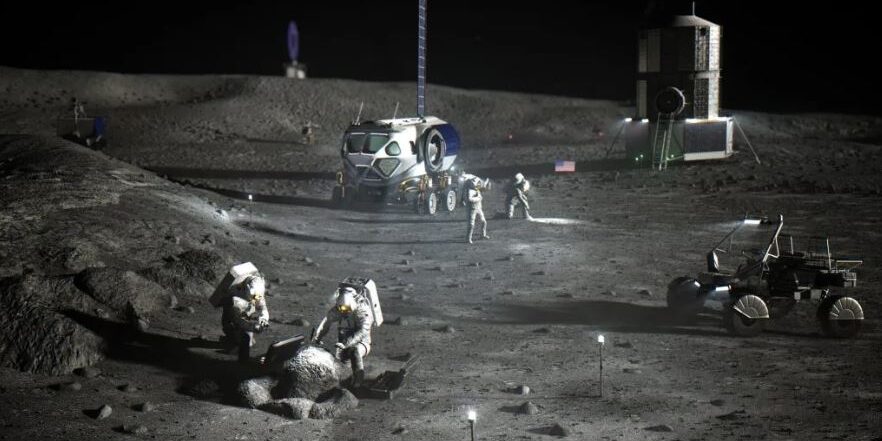
The region between Earth and the Moon has become humanity’s first extraterrestrial industrial zone. By 2035, dozens of companies operate in cislunar space, with activities centered on three key sectors.
Lunar Water Mining: The discovery of substantial water ice deposits in permanently shadowed craters has transformed lunar economics. Companies like Blue Origin’s Blue Alchemist and China’s Chang’e Industrial Corporation operate automated extraction facilities that process thousands of tons of regolith annually. The water they extract isn’t shipped to Earth—transport costs make that impractical—but instead fuels the burgeoning space economy. Electrolyzed into hydrogen and oxygen, lunar water becomes rocket propellant, life support for habitats, and feedstock for industrial processes. This has created the solar system’s first truly off-world commodity market, with water futures traded on specialized exchanges.
Orbital Manufacturing: Free-fall manufacturing facilities in lunar orbit produce materials impossible to create in Earth’s gravity well. Ultra-pure optical fibers, perfect protein crystals for pharmaceutical research, and ZBLAN fluoride glass with properties superior to anything terrestrial manufacturers can achieve—these high-value, low-mass products justify the cost of returning them to Earth. More significantly, orbital foundries process lunar regolith into metal alloys and construction materials that never need to escape a gravity well, serving the expanding infrastructure in space.
Energy Infrastructure: Solar power satellites harvesting continuous sunlight at L1 Lagrange points beam energy to receivers on the lunar surface and to spacecraft throughout cislunar space. This reliable power grid has enabled 24-hour industrial operations and supports the life support systems of growing lunar settlements. While beaming power to Earth remains economically marginal, the technology proves invaluable for sustaining off-world operations.
The Martian Frontier: Building an Independent Economy
Mars in 2035 remains a frontier outpost, but one with accelerating economic activity. Three permanent settlements—Jezero Station, Arcadia Colony, and Olympus Research Base—host a combined population of approximately 2,000 people. Unlike the Moon, which serves primarily as an industrial platform for Earth and deep space operations, Mars is developing toward eventual economic self-sufficiency.
In-Situ Resource Utilization: Martian settlements extract water from subsurface ice, produce methane and oxygen propellant from atmospheric carbon dioxide, and manufacture construction materials from processed regolith. These capabilities reduce—though don’t eliminate—dependence on Earth resupply. The production of rocket fuel on Mars is particularly significant: it enables return missions without hauling propellant from Earth, fundamentally altering the economics of Mars exploration and making scientific missions far more affordable.
Scientific and Intellectual Exports: Mars’s primary exports to Earth remain intangible. Geological discoveries reshape our understanding of planetary formation. Paleontological research searching for ancient Martian life attracts billions in research funding. Climate modeling using Mars as a natural laboratory for planetary atmospheres informs Earth’s climate science. Universities and research institutions maintain permanent facilities, employing hundreds of scientists whose findings flow back to Earth at light speed, even as the researchers themselves may spend years on Mars.
Early Manufacturing: Small-scale manufacturing of specialized equipment—replacement parts, tools optimized for Martian gravity and atmospheric conditions, and experimental materials—serves local needs. Some products, like pharmaceutical compounds produced in Mars’s low gravity or unique radiation environment, show promise as high-value exports, though shipping costs still limit commercial viability.
The Martian Labor Market: Compensating workers on Mars creates unique economic challenges. Base salaries are high—reflecting the risks, isolation, and specialized skills required—but much of the compensation takes the form of Earth-based benefits. Stock options, retirement accounts, and educational funds for children back on Earth ensure that Martian workers accumulate wealth they can access when they return. This creates a curious duality where Mars residents are often highly compensated but live in relative austerity, unable to spend much of their earnings until they return to Earth.
Earth: Market Hub and Manufacturing Base
Earth remains the economic center of gravity—home to nearly all consumers, the vast majority of manufacturing capacity, and the financial systems that fund off-world development. Yet Earth’s role is changing as space industries mature.
Space-Enabled Terrestrial Services: Communications constellations, Earth observation satellites, and navigation systems represent the most mature space markets, generating hundreds of billions annually. These services directly benefit Earth-based customers—from precision agriculture guided by satellite data to global internet connectivity in remote regions.
Technology Transfer: Technologies developed for space find terrestrial applications. Closed-loop life support systems designed for Mars habitats inform sustainable building practices on Earth. Autonomous robotics developed for lunar mining operations transform Earth-side industries from deep-sea exploration to disaster response. Medical technologies for monitoring astronaut health in isolation enhance telemedicine capabilities globally.
Rare Materials Market: While asteroid mining hasn’t yet scaled to the point of flooding Earth markets with platinum or rare earth elements, small quantities of ultra-pure materials produced in orbital foundries command premium prices. Semiconductor manufacturers pay handsomely for defect-free silicon crystals grown in microgravity, while pharmaceutical companies value protein crystals that reveal molecular structures impossible to determine from Earth-grown samples.
Supply Chains Across the Void: Logistics Revolution
The space economy’s most profound innovation isn’t any single technology—it’s the creation of interplanetary supply chains that function despite months-long transit times and communication delays measured in minutes.
The Orbital Logistics Network
By 2035, cargo doesn’t simply launch from Earth to its final destination. Instead, a network of orbital depots, transfer stations, and fuel production facilities enables multi-hop journeys that dramatically reduce costs.
Consider a shipment of scientific equipment bound for Mars. The payload launches from Earth to Low Earth Orbit on a reusable heavy-lift vehicle. There, it transfers to a lunar-bound tug that refuels at a depot stocked with propellant from lunar water. The cargo reaches a lunar orbital transfer station, where it’s consolidated with other Mars-bound shipments and loaded onto a cycler—a spacecraft in a permanent Earth-Mars orbit that swings past both planets regularly, never landing but serving as a cargo bus. Finally, a Mars descent vehicle ferries the equipment to the surface.
This complex choreography succeeds because of standardization. Cargo containers, docking mechanisms, and communications protocols follow universal standards developed through international cooperation. Companies specialize in particular segments—Earth launch, orbital transfer, cycler operations, planetary descent—creating efficiency through specialization.
The Great Propellant Economy
Rocket propellant is the oil of the space economy—the fundamental commodity that enables everything else. By 2035, the propellant market has transformed into a sophisticated industry.
Lunar water extraction facilities produce hydrogen and oxygen. Martian chemical plants convert atmospheric CO₂ into methane and oxygen using the Sabatier process. Orbital refineries at various points process these feedstocks into optimized propellant mixtures. Depot stations throughout cislunar space and along Mars transfer orbits stockpile fuel, creating a distributed infrastructure that eliminates the need to carry all propellant from Earth.
This infrastructure enables the economic viability of many space activities. A spacecraft can launch from Earth with minimal fuel, knowing it can refuel cheaply in orbit from lunar-produced propellant. This reduces launch masses by 60-70%, making missions affordable that would otherwise be prohibitively expensive. The propellant market itself becomes valuable—futures contracts for delivery of hydrogen-oxygen or methane-oxygen at specific orbital locations trade actively, with prices fluctuating based on production capacity, demand from upcoming missions, and the political stability of producing regions.
Market Integration: How Off-World Commerce Affects Earth
The space economy isn’t isolated from terrestrial markets—it’s increasingly integrated, creating feedback loops that affect both domains.
Investment and Capital Flows
Space ventures attract massive capital investment. By 2035, dedicated space economy funds manage over $800 billion in assets, investing in everything from launch providers to lunar mining operations to Martian agricultural research. Sovereign wealth funds from resource-rich nations diversify into space resources, seeing parallel opportunities to their terrestrial extractive industries.
Public markets reflect this enthusiasm. Major stock exchanges list dozens of space-focused companies. Some, like SpaceX and Blue Origin, have achieved trillion-dollar market capitalizations. Others remain speculative—lunar mining companies valued on projected future revenues from resources not yet extracted, or Martian land development corporations banking on eventual colonization.
The investment flows bidirectionally. Profits from mature space services—communications satellites, Earth observation—fund riskier ventures in lunar manufacturing or Mars exploration. Meanwhile, successful technology development for space applications spins off into terrestrial companies, creating value that accrues to Earth-based shareholders.
Labor Markets and the Brain Drain Debate
The space economy creates demand for highly skilled workers—engineers, scientists, technicians, doctors, and even teachers for the children of space workers. By 2035, approximately 15,000 people work in space or on other celestial bodies at any given time, with annual rotation bringing total employment over 30,000.
This creates tension in terrestrial labor markets. Salaries for space-qualified professionals rise substantially, pulling talent from Earth-based industries. Some nations worry about a brain drain as their best engineers and scientists migrate to space corporations. Others embrace it, seeing space employment as a prestige export that brings wealth back when workers return.
The ripple effects extend broadly. Universities expand aerospace engineering and planetary science programs to meet demand. Training facilities specializing in space operations proliferate. Communities near spaceports boom, while others fear being left behind in the new economy.
Regulatory Arbitrage and Governance Challenges
The space economy operates in a regulatory gray zone. The 1967 Outer Space Treaty prohibits national sovereignty claims over celestial bodies but doesn’t clearly address commercial resource extraction or property rights. By 2035, this creates opportunities and risks.
Some companies exploit regulatory ambiguity, incorporating in jurisdictions with favorable space commerce laws. Luxembourg and the United Arab Emirates compete to be the Delaware of space incorporation, offering legal frameworks that recognize property rights in extracted resources and provide tax advantages.
Meanwhile, international efforts to establish clearer governance proceed slowly. The United Nations’ Committee on the Peaceful Uses of Outer Space works on frameworks for resource extraction, safety zones around lunar and Martian installations, and traffic management in increasingly crowded orbital space. Progress is deliberate, balancing competing national interests and the desires of spacefaring nations to avoid constraining commercial innovation.
Sector Spotlight: Key Industries Shaping the Space Economy
Space Tourism and Hospitality
By 2035, space tourism has evolved from billionaire joyrides to a mature industry serving tens of thousands annually. Orbital hotels offer week-long stays in microgravity, complete with observation domes, fine dining adapted to zero-g, and activities from spacewalks to orbital sports. Tickets cost $250,000 to $500,000—still expensive, but within reach of affluent tourists rather than only the ultra-wealthy.
Lunar surface tourism remains exclusive. A two-week trip to the Moon—including orbital cruise, surface landing, and exploration of historic Apollo sites—costs $10-15 million. Still, several hundred people make the journey annually, supporting a small but profitable industry.
Mars tourism exists only in planning. The journey’s duration (six to nine months each way), radiation exposure, and physiological challenges make it unsuitable for casual visitors. The few non-professional astronauts who reach Mars are typically wealthy individuals funding their own research projects or joining documentary expeditions.
Pharmaceutical and Biotech Research
Microgravity and Mars’s unique environment prove invaluable for certain research applications. Protein crystallization experiments in orbital laboratories produce structures that reveal drug targets impossible to identify from Earth-grown crystals. Several major pharmaceuticals approved in the early 2030s trace their development to space-based research.
Martian research focuses on extremophile biology and radiation effects. Understanding how organisms adapt to Mars’s harsh conditions informs everything from cancer treatment (radiation resistance mechanisms) to antibiotic development (studying microbes in extreme environments). The intellectual property generated—patents, research data, novel organisms—represents one of Mars’s most valuable exports.
Energy and Materials
The materials sector remains nascent but promising. Lunar regolith processing yields construction materials, rare earth elements, and aluminum and titanium alloys. For now, these serve primarily space-based construction—building new habitats, manufacturing facilities, and spacecraft. The economics don’t yet justify shipping bulk materials to Earth.
However, specialized materials command premium prices. Ultra-pure semiconductors grown in microgravity, exotic alloys impossible to produce in gravity, and isotopically enriched materials for scientific research—these niche products find terrestrial buyers willing to pay for their unique properties.
The energy sector focuses on enabling space operations rather than serving Earth markets. Solar power arrays on the Moon and in orbital stations power industrial facilities. Nuclear reactors provide baseline power for Martian settlements. Research continues on fusion power, with some believing the space environment’s advantages (abundant helium-3 on the Moon, isolation for safety) might make space the birthplace of practical fusion energy—which could eventually benefit Earth.
Financial Innovation: New Instruments for New Markets
The space economy has spawned financial innovations as creative as its technical achievements.
Commodity Futures Beyond Earth
The Chicago Mercantile Exchange’s Lunar Commodities Division trades futures contracts for lunar water, processed propellants, and rare earth elements. These instruments allow space companies to hedge against price fluctuations and production uncertainties. A Mars-bound mission can lock in propellant prices years before launch, protecting against supply disruptions or production shortfalls at lunar facilities.
More exotic instruments emerge. Launch capacity futures let companies reserve rocket payload space years in advance. Orbital slot derivatives provide price exposure to the value of specific orbits. Even Martian land certificates trade, though their legal status remains questionable—representing bets on future governance decisions as much as actual property rights.
Space Bonds and Development Finance
Large infrastructure projects—lunar bases, Mars settlements, orbital manufacturing complexes—require capital expenditures in the tens of billions. Traditional project finance struggles with the uncertainties and timelines involved.
Space development bonds emerge as a solution. These long-term instruments (30-50 year maturities) fund specific projects, with returns backed by projected revenues from facility operations. The European Space Agency’s lunar polar base, for instance, issued €20 billion in bonds backed by anticipated water extraction revenues and facility leasing income. While risky, these bonds attract investors seeking diversification and believing in space economy growth.
Governments also use bonds to finance their space activities, seeing parallels to historical infrastructure investments in railroads or canals. China’s Belt and Road Space Initiative funds orbital stations and lunar facilities through sovereign bonds, viewing space infrastructure as key to long-term economic competitiveness.
Insurance and Risk Markets
The insurance industry grapples with space’s unique risks. Launch insurance has existed for decades, but the expanding space economy requires new products. Life insurance for Mars colonists must price the unknown health risks of multi-year exposure to reduced gravity and elevated radiation. Cargo insurance covers not just launch failures but in-space collisions, equipment malfunctions, and even piracy as valuable cargo moves through sparsely monitored regions. Business interruption insurance protects lunar facilities against equipment failures that could halt production for months while replacement parts travel from Earth.
The Geopolitical Dimension: Competition and Cooperation
Space economy development occurs against a backdrop of national competition and international cooperation. The major spacefaring powers—the United States, China, the European Union, India, and Russia—pursue parallel strategies, creating both redundancy and innovation.
National Strategies
The United States leads in commercial space activity, with companies like SpaceX, Blue Origin, and dozens of smaller firms driving innovation. NASA’s Artemis program established permanent lunar presence, which private companies now leverage for commercial purposes. The U.S. strategy emphasizes public-private partnerships, using government contracts to de-risk private investment while maintaining regulatory oversight.
China pursues a state-led approach, with the China National Space Administration coordinating civilian and military space activities alongside state-owned enterprises. China’s lunar base at the South Pole and its Mars research station demonstrate significant capabilities. Increasingly, China allows private companies to participate, creating a hybrid model that combines state direction with market competition.
The European Union emphasizes international cooperation and sustainable development. ESA’s lunar village concept brings together multiple nations and companies in shared facilities. European companies specialize in precision manufacturing and advanced robotics, finding niches in the broader space economy supply chain.
India leverages its low-cost engineering capabilities to offer affordable launch services and satellite manufacturing. Its growing private space sector attracts investment, while ISRO’s successful Mars and lunar missions demonstrate technical competence.
Areas of Cooperation
Despite competition, cooperation proves necessary. The International Lunar Research Station combines Chinese and Russian efforts with participation from several smaller nations. The Artemis Accords, signed by over 40 countries, establish norms for lunar and Martian resource extraction, safety zones, and scientific data sharing.
Technical standards require international agreement. Docking mechanisms, communications protocols, and emergency procedures must work across national systems—astronauts’ lives depend on it. The International Space Coordination Council coordinates these standards, much as terrestrial bodies standardize aviation or maritime practices.
Scientific cooperation remains strong. Mars exploration, being enormously expensive, benefits from shared resources. The International Mars Research Consortium pools data from multiple nations’ missions, accelerating discovery while reducing duplication. Climate monitoring from space similarly requires international cooperation—Earth’s atmosphere doesn’t respect borders.
Challenges and Vulnerabilities
The space economy’s rapid growth shouldn’t obscure real challenges that could derail progress.
Technical Risks
Space remains dangerous. A catastrophic failure—a habitat breach killing dozens, a reactor meltdown contaminating a lunar facility, or a collision between spacecraft in crowded orbital lanes—could trigger regulatory backlash that stifles the industry. The sector operates under constant pressure to maintain safety while managing costs.
Long-term health effects of reduced gravity and elevated radiation remain incompletely understood. If Mars colonists develop severe health problems after years of exposure, it could undermine support for deep space settlement and shift resources toward nearer-term lunar activities.
Economic Sustainability
Many space ventures remain unprofitable or marginally profitable, sustained by investor optimism about future growth. If key companies fail to meet revenue projections, investor sentiment could sour, triggering a funding drought that slows development.
The space economy also depends on continued terrestrial prosperity. Economic recession on Earth could reduce tourism, cut research budgets, and dry up capital for space ventures. The sector’s growth assumes ongoing Earth-based wealth to fund its development.
Regulatory and Legal Uncertainty
Unclear property rights inhibit investment. Companies hesitate to invest billions in lunar mining if they’re uncertain whether they can legally own what they extract. International efforts to clarify these rules make progress, but disagreements persist about how to balance commercial interests with the principle that space belongs to all humanity.
Looking Beyond 2035: The Path to True Multi-Planetary Economy
By 2035, the space economy remains in transition—no longer purely experimental but not yet fully mature. Earth dominates economically, the Moon serves as an industrial platform, and Mars remains a research outpost moving toward self-sufficiency. The critical question is whether this trajectory continues.
Several developments would accelerate progress. Breakthrough propulsion technologies—nuclear thermal rockets, fusion drives, or even theoretical concepts like solar sails or electromagnetic launch systems—could dramatically reduce transport costs. Advanced automation and artificial intelligence might enable more complex operations with smaller human crews, reducing life support costs. Discovery of easily accessible rare resources on asteroids or Mars could create compelling economic incentives for expansion.
Conversely, setbacks could slow or even reverse progress. Major accidents, prolonged economic recessions on Earth, or international conflicts that militarize space could freeze development for years or decades.
Most likely, progress continues but unevenly—periods of rapid advancement alternating with consolidation and occasional setbacks. By the 2040s, the Moon may host permanent settlements numbering thousands, with Mars colonies achieving genuine self-sufficiency in essential resources. Earth remains the economic center but increasingly relies on space for critical materials and technologies.
Conclusion: The Economics of Becoming Multiplanetary
The space economy of 2035 represents humanity’s first serious attempt to establish economic activity beyond Earth’s surface. What makes this moment different from previous space enthusiasm is the emergence of real, if nascent, markets. Companies generate revenue from space tourism, orbital manufacturing, and resource extraction. Supply chains extend across the void. Financial instruments price risk and enable investment across unprecedented distances.
The connection between lunar and Martian industries and terrestrial markets remains asymmetric. Earth exports capital, technology, and skilled workers to space. Space exports knowledge, niche materials, and the promise of future abundance. Over time, as space operations scale and technology matures, this relationship may equilibrate—but for now, space economy growth depends critically on Earth’s willingness to invest in a future that won’t fully materialize for decades.
This investment isn’t purely financial calculation. It reflects humanity’s aspiration to transcend planetary limits, to become a species that inhabits multiple worlds. The space economy of 2035 serves both practical functions—generating returns, enabling research, providing services—and symbolic ones, demonstrating that humanity can thrive beyond the world that birthed it.
Whether this first flowering of multiplanetary commerce proves sustainable depends on countless variables—technological breakthroughs, political will, economic conditions, and perhaps simple determination. But by 2035, the question is no longer whether humanity can build an economy in space, but how large and interconnected that economy will become, and how profoundly it will reshape both our terrestrial markets and our understanding of what economic activity can be.
@ImageCredits: NASA