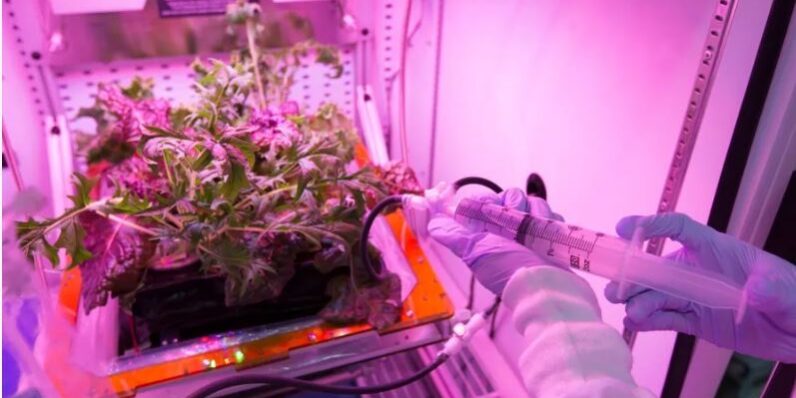
An exploration of farming in asteroid soil simulants and closed-loop ecosystems
While humanity’s ambitions extend beyond Mars and into the deeper reaches of our solar system, a radical agricultural frontier is emerging: farming on asteroids. While growing crops in Martian soil has captured popular imagination, the asteroid belt may hold even greater promise as a network of self-sustaining food production stations scattered throughout space.
Why Asteroids?
The asteroid belt between Mars and Jupiter contains millions of rocky bodies ranging from the massive Vesta (329 miles in diameter) to small chunks less than 100 feet across. But researchers envision creating pit stops for food throughout space, transforming select asteroids into robotic farms that could support deep space exploration without relying on Earth resupply missions.
Unlike Mars or the Moon, asteroids—particularly carbonaceous chondrite asteroids—may offer unique advantages. CI carbonaceous asteroids are of interest because the regolith is suggested to contain soluble elemental nutrients, such as phosphorous and potassium, that crops can use for growth. These primitive bodies retain materials from the early solar system, potentially providing natural fertilizers locked within their dusty surfaces.
Growing in Asteroid Simulant: The Research
Pioneering research at the University of North Dakota has taken the first steps toward asteroid agriculture. Scientists created a simulant based on the Orgueil meteorite—a CI carbonaceous chondrite that crash-landed in France in 1858—and tested whether common crops could survive in mixtures of this material and peat moss.
The results were both encouraging and sobering. Mediums with up to 25 percent of simulant performed well for plant growth when growing lettuce, radishes, and peppers. However, pure asteroid simulant proved challenging. The material is incredibly fine—described as the blackest soil ever seen, immediately sending a dust cloud into the air—and when water is added, it simply seeps through without retention.
Research revealed several obstacles: the simulant is prone to compaction and crusting, leading to drought stress on crops. Despite containing small amounts of plant-usable nutrients, the material’s high pH and low cation exchange capacity made it a poor standalone growing medium.
Making Asteroid Regolith Work
The challenges haven’t deterred researchers. Several strategies are being explored to transform raw asteroid material into productive agricultural substrate:
Organic amendments: Adding composted biomass or other organic matter could improve water retention and nutrient availability—effectively converting regolith into soil over time.
Fungal transformation: NASA-funded research is investigating seeding asteroids with fungi to break down regolith and produce soil, creating a biological pathway to soil formation that could operate autonomously.
Nutrient extraction: Scientists are exploring extracting present nutrients from regolith to create hydroponic solutions, offering a more controlled approach to plant nutrition.
Microbial inoculation: Beneficial bacteria, particularly nitrogen-fixing species, could establish symbiotic relationships with plants while enriching the substrate with essential nutrients.
Closed-Loop Ecosystems: The Key to Sustainability
Asteroid farming cannot exist in isolation—it must be part of a larger Bioregenerative Life Support System (BLSS). These sophisticated closed-loop ecosystems recycle air, water, and nutrients with minimal external input, creating self-sustaining environments essential for long-duration space missions.
The concept is elegant: plants produce edible biomass, oxygen, and water as resources for astronauts, starting from carbon dioxide, wastewater and other wastes. In return, humans provide the carbon dioxide plants need for photosynthesis, while their waste products are processed back into nutrients.
Projects like the European Space Agency’s MELiSSA (Micro-Ecological Life Support System Alternative) have been developing these interconnected biological compartments since 1989. The system links multiple organisms—from microalgae to higher plants—each performing specific functions in the resource cycle.
Historical experiments have provided crucial lessons. Russia’s BIOS-3 facility in Siberia successfully supported human crews for extended periods using hydroponic crop production. The more famous Biosphere 2 in Arizona, despite its challenges with oxygen fluctuations and ecosystem imbalances, provided unparalleled data on bioregenerative life support systems under material closure.
The Vision: Robotic Asteroid Farms
The ultimate goal is ambitious yet practical: autonomous agricultural stations scattered throughout the solar system. Once humans establish a biodome on the surface of a large asteroid, advanced robotics are expected to take over operation, creating self-replicating systems that service crops without human presence.
Imagine a future where spacecraft traveling to the outer planets can dock at asteroid way-stations, replenishing food supplies grown locally from asteroid materials. These farms would operate in the low gravity of small bodies, using transparent domes to capture sunlight and artificial lighting during periods away from the sun.
The technological requirements are steep: radiation shielding, atmosphere retention, temperature control, and automated crop management all in microgravity. But each challenge presents an engineering opportunity rather than a fundamental barrier.
Terrestrial Benefits
Research into space agriculture isn’t just about feeding astronauts. The closed-loop systems being developed could revolutionize Earth-based agriculture, particularly in resource-limited environments. Techniques for growing crops in marginal substrates, maximizing water recycling, and creating self-sustaining ecosystems have direct applications in arid regions, urban farming, and climate-challenged areas.
The quest to farm asteroids is pushing the boundaries of plant biology, ecology, and sustainable agriculture. We’re learning to grow food with minimal inputs, to recycle every resource, and to work with materials once thought completely unsuitable for cultivation.
Looking Forward
The ability to use asteroid regolith as a local, in situ resource for growing crops would greatly improve the sustainability and self-sufficiency of long-duration space missions. While current research shows pure asteroid material cannot yet support robust plant growth, the path forward is clear.
Future research will focus on testing diverse crop varieties, optimizing organic amendments, understanding microbial communities in space regolith systems, and studying how microgravity affects plant-soil interactions. The knowledge gaps are significant, but so is the potential payoff.
As one researcher put it, “What we’re doing now, we’ll see the fruits of that labor in our lifetime”. The ideas are fresh, experiments are underway, and the dream of self-sustaining space agriculture is transitioning from science fiction to scientific reality.
The asteroid belt may seem an unlikely breadbasket, but with continued research and technological development, these ancient rocks could become the gardens that enable humanity’s expansion into the cosmos. From dust to dinner—that’s the promise of asteroid agriculture.
The future of space exploration depends not just on rockets and robots, but on our ability to live sustainably beyond Earth. Asteroid agriculture represents a crucial piece of that puzzle, transforming barren space rocks into sources of life and nourishment for the next generation of cosmic pioneers.
@imagecredits: Veggie NASA